Showing posts with label journey maps. Show all posts

Sunday, December 15, 2013

Does Social Media Impact Ecommerce Sales?

via Practical Ecommerce http://www.practicalecommerce.com/articles/61594-Does-Social-Media-Impact-Ecommerce-Sales

Black Friday online sales hit a record of $1.2 billion, according to published reports. But only a very small percentage of those sales could be attributed to social media, says an IBM report.
In analyzing traffic and sales from nearly 800 retailers, IBM found that only 1 percent of visits to ecommerce sites came from social networks. (To be clear, IBM’s measurements consisted of sales that could be directly attributed to traffic from social media — a “last click” from the social site to an ecommerce site.)
These findings are commensurate with a 2011 survey conducted by Practical Ecommerce, which revealed that 77 percent of responding merchants saw less than 5 percent of sales coming from social media.

Social Media’s Role in Customer Purchase Journey

If social media has little bearing on direct sales, then what purpose does it serve in the overall ecommerce sales continuum?
An article from Google Think Insights points out that social media does, indeed, play a role, albeit a supplementary one.
The article outlines four different segments where marketing channels fit along the customer path to purchase: Awareness, Consideration, Intent, and Decision.
Google divides the customer purchase path into four segments.
It refers to the first three as “Assisting” channels, which “build awareness, consideration, and intent earlier in the customer journey.” In each of the industries considered, including retail, social media functioned as a means to influence purchases rather than be directly responsible for them.
Social media assists in the purchase process.

5 Benefits Gleaned From Social Media

Despite not being a direct sales channel, social media can support ecommerce in the following ways.
  • Promote brand awareness. One of the chief benefits social media provides is its ability to help retailers build brand awareness. A survey conducted by online marketing tools vendor Wishpond found that 89 percent of respondents said social media marketing generated more business exposure.
Due to its viral nature and ability to quickly and easily spread a message, brands that commit to regular posting of relevant content on social sites grow their base of fans and followers, and have ongoing interaction with them should, over time, expect to see an uptick in awareness.
  • Help overcome customer reluctance to purchase. While customers still express some degree of confidence in advertising messages, that pales in comparison to their reliance on word of mouth, especially when it comes from trusted sources such as family and friends.
According the most recent Nielsen Trust in Advertising report, 84 percent of those surveyed said word of mouth was the most influential factor when deciding on a purchase. Consumer opinions posted online ranked third at 68 percent.
If “trust” is a potent factor in convincing consumers to purchase a product, through its focus on building relationships and fostering interaction, social media can serve as a channel to help consumers overcome their reluctance.
  • Improve customer loyalty. In a day when customers are one click away from doing business elsewhere, the importance of increasing customer loyalty and lifetime value cannot be overstated.
By building relationships with new customers and strengthening relationships with existing ones via social networks, it stands to reason both will increase.
  • Provide marketing insights. Even retailers who choose not to pro-actively participate in social media can benefit by listening to the groundswell of opinion expressed by consumers on such sites.
If it’s true that people trust recommendations and advice from other people online, then it behooves merchants to make a practice of hearing what these folks have to say about their brand, products and services.
  • Support search engine optimization. In her Practical Ecommerce article, “SEO: 5 Reasons Not to Ignore Google+,” search marketing expert Jill Kocher cited a report from search marketing tools vendor Moz, which stated there is a correlation between higher search rankings and Google +1s.
“Though Google denies that +1s are an algorithmic factor in search rankings, some speculate that sharing content on Google+ has a causal relationship with higher Google rankings. As Google’s social network becomes more mainstream, we can expect its social signals to be incorporated into Google’s search algorithms,” said Kocher.
If that is the case, or soon will be, then social media participation merits consideration for SEO purposes alone.

Recommendations for Merchants

  • Think Social, Not Shopping. Facebook and other social networks are “social” environments where people gather to share updates about their lives and interact with friends, not as a place to shop.
Merchants can still utilize the channel, but have to think differently about their approach. The experience needs to remain social, interactive and contextual. They should balance promotional posts with those that educate, inform and entertain, and put the needs and interests of customers above their own.
  • Start with a Strategy. Merchants need to first determine the reason they want to participate in social media and what they expect the outcomes to be. Unfortunately, strategy is often usurped by tactics, leaving such outcomes uncertain.
  • Establish Measurable Objectives. Even with a strategy in place, unless there are hard numbers associated with it in the form of measurable objectives, merchants may not be aware of social media’s impact on their business.
Objectives can fall under several categories including:
  • Traffic from social media to their ecommerce site;
  • Ratio of traffic from social networks to conversions;
  • Number of fans and followers that represent their target market;
  • Ratio of social media audience growth to overall sales;
  • Ratio of social network engagement (comments, likes, shares) to sales;
  • Number of repeat sales from customers connected to their brand via social media;
  • Percentage of customer service inquires handled through social media as opposed to a traditional channels.
These represent but a few of the ways to tie social media to sales. For more insight, read the Practical Ecommerce article, “How to Measure Social Media Marketing; 3 Steps.”

Conclusion

Even though social media has not proven to be an direct sales panacea, the ability to build brand awareness, overcome reluctance, increase customer loyalty, provide marketing insights, and improve SEO makes it a worthwhile channel that merchants can use to influence purchase behavior over the long term.

Tuesday, November 12, 2013

Understanding Ecommerce Shoppers: Who, Why, Where, When, How

Most ecommerce merchants can describe their customers in a general way. They likely know basic demographics — age range, gender, income level. But, do they understand the “why,” “where,” “when,” and “how” their customers make their purchases? These basic tenants of marketing are more important than ever.
The buying process has never been more complex. Consumers have hundred of places online to purchase products that meet their needs. They may shop at home, at work, in the grocery store. They may be using an Android phone, an iPhone, or an Xbox.
The best place to start understanding your customer is to put yourself into every step of a buying cycle and analyze what influences various purchase decisions.
This article will provide a template.

Who Is your Customer?

This is basic demographics and usually includes the following.
  • Age range
  • Gender
  • Marital status
  • Income level
  • Education level
  • Location
  • Profession
Many of these basic demographics can be inferred from your interactions with customers. In many cases, you can simply ask them.
Beyond the basics, you will also benefit from more personal data, such as the following.
  • Interests
  • Activities
  • Political affiliation
That data is harder to access, but there are databases that will allow you to target individuals based on those criteria. Facebook’s ad platform provides an incredible amount of targeting data. You can infer your customer profiles by the types of results you get by running ads aimed at specific target markets. That will help identify the interests of your customers.

What Does your Customer Need to Know?

Next, consider what consumers need to know about a product to make a purchase.
  • What does it looks like?
  • How does it function?
  • How big is it?
  • What sizes and colors are available?
  • What options are there?
  • How much does it cost?
  • Are there ongoing costs?
  • Is there a warranty?
  • How long will it last?
  • What are its specs?
  • Does it need anything else to make it work?
To find those details, shoppers will seek different sources: articles, websites, blogs, and actually looking at products and trying them on.
Make sure you understand the “what” questions for your products. Then, provide answers to those questions.

Why Do Consumers Purchase your Products?

The “why” questions are important. Do you know why your customers buy your products? It could be for the following reasons.
  • Address an immediate need or desire.
  • Need product occasionally or on a regular schedule.
  • Shop around every time they buy.
  • Loyal to a particular brand or store.
  • Purchase because product is cool or trendy.
  • Seek the lowest price possible.
  • Seek little or no shipping or sales tax.
  • Need flexibility to return products.
  • Seek high-quality products.
  • Seek bargains.
The answers will surely vary. Consider, also, what motivates your customers to purchase the products you sell and also why they purchase them from your company versus your competitor. This will help you better refine your value proposition of why shoppers choose your company.

How Do Customers Research your Products?

This area is the most significant change in a consumer’s shopping cycle. As recently as 15 years ago, most product research was done in stores or catalogs or magazines. Today, product research is done in many ways. In the living room, in the boardroom, at the hospital, you name it. Most shoppers start their search at Amazon.com or on Google by searching on a product. Or do they?
Many searches start with an opportunistic email promoting a product. From there, we may find the shopper looking at the item on that store’s website. She may then branch out and see what Amazon has that is similar. In some cases, she may table that thought. In other cases, she may decide to shop around at many stores.
Consumers likely check product reviews, from other consumers. They may read professional reviews. They may do that on their large screen monitors at home. But, they may also be sitting in an animal hospital at 10 p.m. waiting for their dog to have surgery, as I did last night. All I had to do there was browse the Internet on my iPhone.
The point is to understand your customer’s research process. It will vary widely. But in many cases it’s something like this.
  • An event triggers an interest in a product.
  • Conduct research by looking at a product’s pictures, reading descriptions and so forth.
  • Seek out reviews or ask friends.
  • Check other brands or alternative products.
  • Narrow your selection and shop for price.
  • Evaluate the product’s real value, and eventually make a purchase decision.

Where Do they Research?

That leads us to the where customers are researching. They could be reading relevant blogs, going to brick and mortar stores, checking comparison shopping engines, and reading trade publication articles. They may be looking at Pinterest boards, Facebook posts, and checking with their network of friends on Twitter.
They will be using tablets (increasingly the shopper’s preference), smartphones, laptops, desktops, Xboxes, and store visits.
Can an ecommerce merchant be in all of these places with your message? Likely no. But you can identify where your customers are looking for information as they move through their cycle and try to make sure you are seen. You can also ensure that your messaging and content are mobile friendly.
To compete in the future, your store needs to provide input and information to support all those steps. If you lack reviews, your customers will seek them out elsewhere.

via Practical Ecommerce http://www.practicalecommerce.com/articles/59898-Understanding-Ecommerce-Shoppers-Who-Why-Where-When-How

How to Create Compelling Ecommerce Content

In “Content Marketing for Ecommerce Merchants,” I suggested that merchants create relevant content for their shoppers throughout the buying cycle.
There are two ways to approach creating content that will support your social media, merchandising, and promotional activities: (a) Manage the process in house with the staff you have, or (b) Outsource contract content creation to professional writers or agencies.
Both approaches have pros and cons. You may not have a qualified writer on staff to compose interesting posts and content. But your staff is likely to have the subject matter expertise that an outside writer or agency may not.
My view is to keep this activity in house if possible. Your content will likely be more passionate. You will probably save money.
This article will offer tips on how to create interesting content — mostly in house.

Types of Content

Here is a partial list of the types of content ecommerce merchants should be creating. There are many other venues to consider, but this list is a good place to start.
  • Product content. This could include images, videos, descriptions, specifications, options, and more.
  • Promotional content. Promotional content can involve sales, free shipping, new merchandise, and seasonal items.
  • Home page content. Create compelling content on your home page and refresh it often. Focus on seasonal themes and products. Images are more effective than text.
  • Merchandising content. This includes category descriptions and landing pages for ads or promotions.
  • Blogs. Post about your customers, industry, trends, products, your company, employees, and successes. Try to keep posts between 200 and 500 words in length.
  • Newsletters. Newsletters can link to blog posts. Keep newsletters short and relevant, embellishing with images or video
  • Twitter. Use Twitter to communicate customer service matters, promotions, and new products. You are limited to 140 characters or less, but images are welcome. Engage in a conversation if possible. Use hashtags to categorize tweets.
  • Pinterest boards. Create new Pinterest boards that feature your products and showcase how they are used.
  • Facebook posts. Write about trends. Post images. Engage in dialog with your followers. While not required, the 140 character limit is also a good target on Facebook, but you can extend this if desired.
  • Tumblr posts. Tumblr is an alternative or an additional place to blog. Lead with images here if possible as Tumblr, like Pinterest, is visual.
  • Ads. Pay-per-click text ads, Facebook ads, display ads all count as content. Keep your message consistent while tying in appropriate keywords.

Where to Start

First, think about how your prospects might use various types of content. A major consideration is where they are in the buying cycle. If you are trying to initiate a purchase through a promotional incentive, your potential customers may not be in that frame of mind. You will need to inspire them to take action.
If your customers are subscribed to a newsletter for promotions, deliver promotional offers that are concise and focus on savings. Be sure to include a strong call to action with crisp deadlines.
If your prospects are browsing Facebook or Twitter, they are probably not shopping. Your content should be informative and creative. Be concise and include images with your post. Try to encourage sharing with others to extend the reach of your message.
Newsletters can be used in many ways. Try to segment your email list by topics that might include new products, promotions, customer stories, and industry news. You will then be able to target your content.
Your blog should be used to tell stories. Talk about your experiences — personal and as a company. This can be a good place to build a deeper relationship with your customers by sharing your voice and expertise.
Regardless of the venue, once you have a topic in mind, let your passion and voice come through. You will likely know more about your products and industry than your shoppers. Share this information with them. You can write about why you selected a particular product or brand. Talk about its best features, value, options and so forth.
Try to write about things you feel strongly about.

Create a Plan

As you become more experienced with creating content for different purposes, begin thinking about integrating the content and coordinating its publication. Call that a “content plan.” Your plan should include your branding, a consistent message, and some type of topical imagery if possible.
For example, assume your company is adding a new women’s apparel line for the winter season. Here is a content plan.
  • Write a blog post about your new products prior to launch. Tease your readers and tell them about your selection process. Tie it to an industry trend or position the products as a unique offering if possible. Introduce a “theme” for your new winter products. This might include a tagline like “Don’t let the cold freeze your fashion taste.” I have no experience with women’s fashion and this specific tagline might not be the best example. But you get the point.
  • Mention your blog post on Facebook and Twitter. Post a few images of your new products on Facebook and ask your fans which ones they favor. This can help you identify the images to use in your promotions for the products. Facebook is a good place to test messaging and imagery
  • Create a landing page in your store for your new products with images and descriptive content.Plan to reuse your images in several different venues as you launch your products. Your landing page should include images, descriptions, and a clear statement of your value proposition. In other words, why will your shoppers want to buy these new products? Make sure your landing page is mobile friendly.
  • Announce your new product launch in a promotional email. Link to your new landing page and to your blog.
  • Plan a series of posts on Facebook and Twitter. Post several times per day. Talk about a different product in each post. Include images or videos. Provide links to either the product detail or landing pages.
  • Create a new Pinterest board. Promote these new boards on your blog, on Facebook, and on Twitter.
  • Create promotional ads for ad networks. Link your ads to specific products or to your new landing page as appropriate.
  • Consider some type of introductory offer. This offer does not have to be a discount. You can offer free shipping, upgraded shipping, or some other type of incentive.
The key is to reuse existing content whenever you can. Your posts to social media sites can be a short summary that links to more detailed information. The same thing is true about your newsletters. Even your home page can reuse the introductory text and link to more detailed pages.
Use tracking links wherever possible. This will allow you to learn about the paths your customers follow as they explore your content. You can track your referrals in Google Analytics. You can also use tools like bitly to track specific page links.
You can automate many of these activities with various tools. At the very least, use a tool like HootSuite to manage your social posts. This will also give you a dashboard to manage communications with customers who respond back to you.
More sophisticated tools like HubSpot and Silverpop will allow you to manage your blog posts, email, and social media from a central dashboard. They are worth investigating as your content marketing becomes more sophisticated.
via Practical Ecommerce http://www.practicalecommerce.com/articles/60378-How-to-Create-Compelling-Ecommerce-Content

Wednesday, October 23, 2013

The Importance of Visualisation – Mapping the Way Forward


Richard Ingram presenting at the Content Strategy Forum 2013
This is the tidied-up transcript of a talk I gave a month ago at the Content Strategy Forum 2013 in Helsinki, Finland. It was the third consecutive year I’d spoken at the forum and it was quite possibly the most enjoyable talk I’ve given to date.
Note: Though I’ve included screenshots of the most important slides, you might prefer to read along with the full deck.

The importance of visualisation – mapping the way forward

As our species’ love affair with maps is about as old as civilisation itself, I’d like to begin today’s talk by briefly going back all the way to the beginning of human existence. Long before humans could write we have been making and using maps to make sense of the world around us (Figure 1). Each example offers a snapshot into a different time and culture, as well as a unique insight into the political, cultural, and spiritual forces that drive society.
Babylonian map of the world.
Figure 1 – Babylonian map of the world. Clay tablet, probably from Sippar, southern Iraq (c.700-500 BC) © Trustees of the British Museum
Every blank surface you can possibly think of – be it of rock, clay, wood, parchment, paper, or tapestry – has been used to plot places and objects according to their relative spacial positions. And it’s this synthesis of science, art, and history that combines to create these beautiful objects. Every map has its own story to tell and harbours secrets it may never fully reveal. A map can delight, surprise, and unsettle in equal measure. And maps can reveal deep truths – not just about where we’ve come from, but about who we are.
Throughout history the map has demonstrated its versatility. They’ve had an administrative use in marking out national boundaries or individual plots of land, a social use in showing who lives where, a military use in depicting the layout of enemy positions, and a political or propaganda use in showing one country or faction over others. But beyond their two-dimensional depictions of a physical world, maps also afford us the freedom to express the cosmos; to make all kinds of ideas about the spatial relationships of multiple components unexpectedly clear. To draw one is an effective way to establish order on an otherwise chaotic environment. To make it navigable. To make it rational.
City maps are a fine example of creating this impression of order. The whole objective behind creating such a map would be to somehow capture, contextualise, and impose order on an environment which is always moving, growing, and changing. An environment which is falling apart and burgeoning at the same time.
As content professionals, we’re often tasked with making sense of complex, unpredictable, and mostly disorderly environments – home to micro communities with their own agendas, rules, and systems of government. Managing content, processes, and people can be a complex endeavour, and managing them in large systems only increases the complexity.
In his famous map of London published in 1747, John Rocque shows off the perfect enlightenment city (Figure 2). It’s clinical, controlled, and beautiful. This is a map of London at its most picturesque. It’s a map that imposes order on a city of unrelenting change, and it gives all the appearance of objective truth. Rocque has deliberately left out the ugly, unsavoury elements of the city.
John Rocque's 1746 map of London
Figure 2 – John Rocque’s 1746 map of London, which deliberately ignored the city’s unsavoury elements.
To Rocque, it was more important – and lucrative – to present and promote London as the greatest city of its time than it was to present some of its grimier realities. Indeed, mapmakers through the ages have always responded to the mentalities, and met the requirements, of the societies in which they have been created. They quickly learnt that the quality and effectiveness of a map couldn’t simply be judged by its scientific precision, but by its ability to serve its purpose. Without question one of the huge appeals of Rocque’s map was that it successfully imposed order on chaos (Figure 3). This was a visual interpretation of London which offered its inhabitants a sense of promise and a sense of pride as well. To Rocque this map was about imposing clinical precision onto a city which he knew couldn’t literally be accomplished. Why? Because of the human element. And this is the main issue: The thing about cities, like large multi-departmental organisations, is people, and people just make it into a bit of a mad-house.
Roque's London map successfully imposed order on chaos.
Figure 3 – One of the huge appeals of Rocque’s map was that it successfully imposed order on chaos.
If we took it upon ourselves to map a complete and literal visual representation of the way content flows within a mid-to-large organisation, we would, in a sense, be mapping a sprawling city. Such a multiplicity of information would need serious reining in if it were not to cancel itself out in a sorry mess. In the end all drawn city maps, however much they distort the truth, are trying to take on the impossible: They are trying to impose two-dimensional order on the chaos that is urban life.
So we’ve learnt that the quality and effectiveness of a map cannot simply be judged by its scientific precision but by its ability to serve its purpose. Aesthetic and design considerations are every bit as important as the mathematical, and often more so. Indeed, maps of this nature have long served as vital political and negotiating tools. In these cases the intended information inherent to the map has to be conveyed in a way that attracts the eye to certain features. Believe it or not but all this can be achieved with even a simple sketch map. Everything that maps are used to represent: placement, proximity, overlap, distance, and direction can consist of only of a few lines and a few letters, with nothing but the essential features remaining (Figure 4). In short: The simpler the better. Maps like this can be used to quickly and clearly communicate our ideas to others. And if sketched in their presence, you can even use them to tell stories.
An effective map need only consist of a few lines and a few letters.
Figure 4 – Everything that maps are used to represent: placement, proximity, overlap, distance, and direction need only consist of a few lines and a few letters.
Every day we come into contact with various kinds of maps which, on the surface, may look wildly different, but they all share the same basic building blocks (Figure 5). It’s all about picking out the people, places, and things – indeed anything whose relative positions we want to compare – and picturing them in a geographical landscape.
Very different maps, same basic building blocks.
Figure 5 – Different maps, same basic building blocks: Exploded view, Concept map, Star map, and Topological map.
The only real challenge is coming up with a meaningful coordinate system (Figure 6). We’re all well versed in the north-south versus east-west coordinate system, but we can make a map of anything using other pairs of opposites like expensive-cheap versus high-low and fast-slow versus small-large.
Find your coordinate system using pairs of opposites
Figure 6 – Finding your coordinate system. Anything can be mapped using pairs of opposites.
Once we’ve defined our coordinates we can start to plot our landmarks (Figure 7), beginning with the most prominent feature of our landscape. This could be an object, person, or an idea.
When plotting landmarks on your map, start with the most prominent feature.
Figure 7 – Plot your landmarks, starting with the most prominent feature.
And then we can move outward (Figure 8), adding more and features and details, illustrating everything from borders and distances to pathways and sets of shared traits. Let’s make a map!
With your map's most prominent feature in place, move outward.
Figure 8 – Move outward by adding more landmarks to you map.

The unfamiliar environment – finding our way

When it comes to getting a grip of that complex trinity of content, processes and people, governance is an important tool (Figure 9). Put simply, governance determines how key decisions are made and who has the authority to make them. Governance defines who is allowed to create, approve, and publish content, and how these decisions are initiated and communicated.
That complex trinity of content, processes, and people.
Figure 9 – When tackling that complex trinity of content, processes, and people, content governance is an important tool.
One big content governance challenge is maintaining consistency with messaging, communication, editorial and content standards throughout an organisation. This is made particularly difficult when many contributors have other responsibilities and priorities besides content. Governance is primarily a human management issue, but one useful way to help maintain these standards is through content management system (CMS) workflow. This functionality helps manage the sequence of steps from adding or editing to publishing.
Let’s imagine we’ve been hired by a regional English Council to design a new content workflow for their CMS. This council is one of 27 large two-tier non-metropolitan counties used for the purposes of local government in England. Approximately 15,000 staff across seven departments are responsible for providing services to 700,000 local people including education, social care, transport, and culture and leisure. Unsurprisingly, it’s a varied, siloed environment. Some departments take responsibility of hundreds pages on the public website, others only a few. And in the middle of it all is the relatively small Digital Services department trying to keep everyone’s content balanced and consistent.
If you were about to be airdropped into unfamiliar, and possibly hostile, territory, you’d want to be carrying either a map or pairing up with a native guide. So as an outside consultant arriving fresh into this large, diverse, politically-charged environment, your first instinct in making sense of it should be – besides asking for directions to the nearest coffee machine – to draw a map. In order to work out how decisions about content are made around here we need to figure who best to talk to besides Mandy, our main point of contact from the Digital Services department (Figure 10) – particularly those who might be influential to the way things work without even realising it. And to start this process we first need to map out our landscape.
We need to figure out who best to talk to in our varied, siloed environment.
Figure 10 – To discover how content decisions are made and how they could be improved in our varied, siloed environment, we need to figure out who best to talk to.
Since we’ve just arrived in this new environment let’s start by placing ourselves and the rest of the Digital Services department on the map. Next we want to add in the six other council departments (Figure 11): Adults & Communities, Chief Executive’s, Children and Young People, Community Planning, Corporate Resources, and Environment and Transport.
We'll begin mapping our environment by marking out each of the seven departments.
Figure 11 – To begin mapping our environment, we’ll mark out each of the seven departments.
Now we need to introduce a coordinate system (Figure 12). So let’s plot our departments by their relative sizes from small—large, and we’ll also ask Mandy how quickly each department takes, on average, to move through the gears of creating, approving, and publishing content.
Ranking each department by their relative sizes and how long their content takes, on average, to go from creation to publication.
Figure 12 – To devise our coordinate system, we’ll rank each department by their relative sizes and how long their content takes, on average, to go from creation to publication.
Our department’s are plotted, so what can we see? If we’re looking for best performing department we need look no further than Corporate Resources, who, despite their large size, are one of the most efficient at delivering content. On the opposite end of the scale are the Community Planning department, who are small and yet one of the least efficient.
Next we want to understand a little more about the politics of the place. So after surveying various members of the Digital Services department, we can map the pathways between departments that they believe share closer communicative ties (Figure 13).
Mapping the pathways between departments that share closer communicative ties.
Figure 13 – Mapping those pathways helps us get a clearer picture of the politics of the place.
So what jumps out now? Our marked pathways tell us that there are two distinct groups, with one markedly quicker at delivering content than the other (Figure 14).
What can our marked pathways tell us?
Figure 14 – What can our marked pathways tell us?
Perhaps if we wanted to bridge the gap between these two groups the Digital Services team might consider trying to form closer ties with the similarly-sized Community Planning department (Figure 15). If we could improve the efficiency of this relatively small department it might provide a positive knock-on effect. To me, the Community Planning department looks like the ideal place for a pilot project.
Where are the opportunities for improvement?
Figure 15 – Where are the opportunities for improvement?
Now we have our map. It’s by no means scientific or pretty but as I mentioned earlier the quality and effectiveness of a map should primarily be judged by its ability to serve its purpose. Our map may only consist of a few lines and letters but we now have a quick and useful overview of the council’s departmental structure. Not forgetting, of course, that we’ve only just walked through the door.

The unfamiliar environment – mapping out a process

Designing an effective CMS workflow requires meeting the needs of the organisation and each of your content players. In the case of our English regional Council scenario, this is our team of authors spread far and wide across the seven departments. To understand how we can improve the author experience we need to ask each of our content stakeholders to describe their current process for planning, creating, and publishing content.
In our conversation with Mandy, Content Officer in the Digital Services department, she kindly talks us through the typical process for publishing a press release on the council website. I’m not an especially quick note-taker so I always ask permission to record the conversation.
I was always taught never to read your slides, but hey-ho.
“On Monday she received a request from John, Highways Manager at the Environment and Transport department, to publish a press release to inform the community of the start of major road improvement work. She first called Helen, Technical Services Manager at the Environment and Transport department, who emailed through the source material and directed her on the technical details that needed to be included.
She continues…
“After completing the draft in the CMS environment, she marked the press release as ‘ready for review’ and emailed Rachael, a Content Manager and colleague in the Digital Services team, and Helen again for their feedback. After one or two line edits, she was ready to mark the press release as ‘ready for publishing’, so she emailed David, a Digital Media Officer to prepare and publish the press release to the test server.
She continues…
“John, Helen and Rachael were all emailed to help her perform a second review of the content, where they duly approved its publishing to the public website. David then got all the glory as usual by hitting the button marked ‘publish’.”
Now, I don’t know about you but I’m lost. The hardest part of these conversations is keeping track of all the different people, roles, and departments as they’re reeled off. When we hear four, five, six names or more it can be difficult to process them; to find form of the relationships between them. To make sense of this complex drama we can make a map that shows who each character is, how many there are, and how directly and indirectly involved they are in the story.
Let’s begin by listing all the characters we heard just then and their roles before sketching their likeness (Figure 16). Don’t worry too much about accurately portraying their looks. You may not have even met them before, but it’s always a good idea to put a face to a name.
The cast of characters in our story.
Figure 16 – Who are the players in our story?
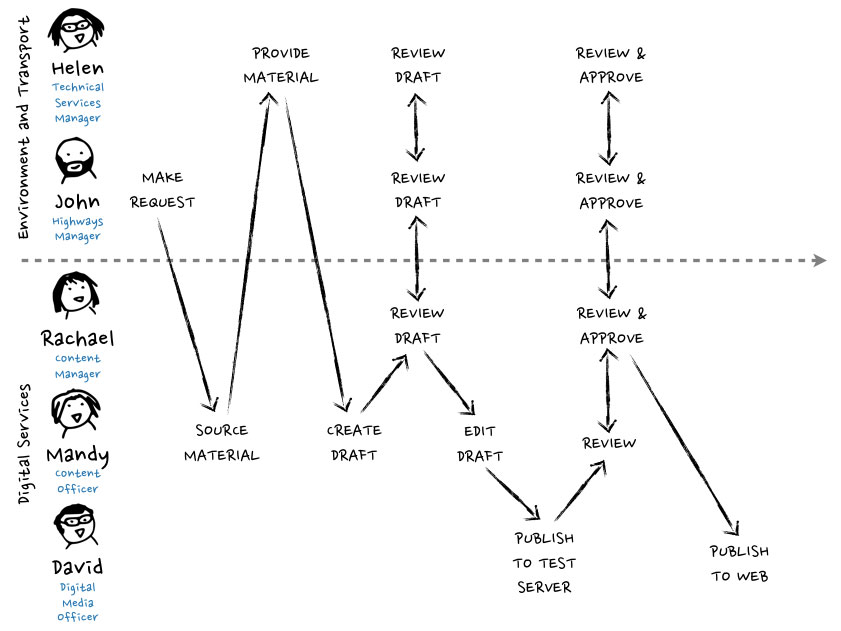
Next we need to separate them by department and plot each interaction and task in chronological order from the initial request to the press release’s publication (Figure 17).
Plotting each character's interactions and tasks.
Figure 17 – Plotting each interaction and task belonging to each character in chronological order (click image to zoom).
This is good. We can clearly see the different roles each character plays and the interactions between them. We can follow this process from the initial request, the research and gathering stage, the creation and subsequent review of the first draft, publishing the draft to the test server, the second round of reviews and approvals, and finally publishing the press release to the web. But we’re still missing features of this story which would further enhance our understanding of this process and how it could be improved. Namely, which interactions and tasks took place in the CMS environment and how long each took to complete.
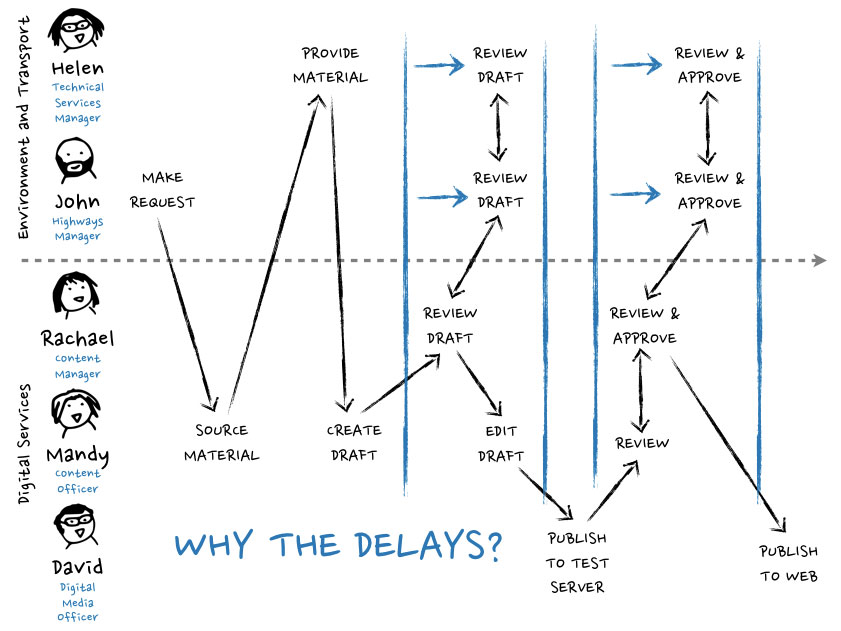
As Mandy almost practically saw the process from start to finish, she’ll be able to help us fill in these details. Let’s first stretch out the timeline to accurately reflect the varying speeds of each interaction (Figure 18).
Stretching out the timeline gives us a more accurate measurement of how long each task took to complete.
Figure 18 – Stretching out the timeline gives us a more accurate measurement of how long each task took to complete (click image to zoom).
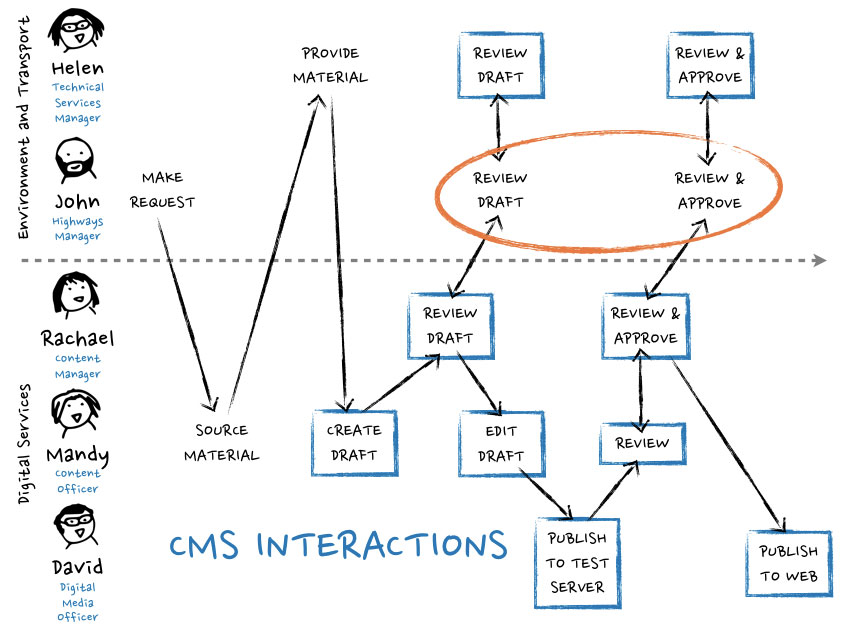
What jumps out now? We can see that John and Helen from the Environment & Transport department took longer than Rachael to review the first draft and to review and approve the test server version. Might that just be because they have other departmental responsibilities besides producing, checking, and updating website content? Possibly. Let’s see what happens when we mark out which interactions and tasks took place within the CMS environment (Figure 19).
Highlighting which interactions and tasks took place within the CMS.
Figure 19 – Highlighting which interactions and tasks took place within the CMS environment might help us reveal where the bottlenecks are in the process (click image to zoom).
Aha! Interesting! John appears to be carrying out his reviews outside of the CMS. How come? To answer this we need to return to our first map.
We can see the Transport and Environment department are on the slower end of the scale in terms of moving through the gears of creating, approving, and publishing content (Figure 20). After interviewing Helen we learn that the department is comprised of three sub-departments: Transportation, Highways, and Environment.
Breaking down the Transport and Environment department.
Figure 20 – Breaking down the Transport and Environment department.
John resides in the Highways sub-department, who we discover has no direct access to the central CMS because of their geographic location elsewhere in the county, and thus is effectively an external contractor (Figure 21). Helen tells us that John has to use email to communicate his requests, edits, and approvals.
The failings of the sub-department might be down to CMS workarounds adding unnecessary time and cost.
Figure 21 – John’s failing sub-department might be down to CMS workarounds adding unnecessary time and cost.
It all makes sense now. The reaction times of the Highways sub-department is adding unnecessary time and cost to this and many other content production processes. It’s compromising the efficiency of the Transport and Environment department and the entire organisation. The intrepid explorer would be wise to investigate whether other departments on the slower end of the scale may be affected when broken down like this. There could be incredible cost-saving potential across the board and opportunities to form closer collaborative ties between departments.
And all this from a couple of fairly simple hand-sketched maps.

The power of drawing – mapping the way forward

Anything to do with aligning content, process, and people is bound to be tough, messy, and complex. But remember that we and others who inhabit these environments are not completely constrained by what has happened before. It is a natural reaction of ours to try to order an environment by fitting it into the categories of our expectations. So when we cannot find a way to fit any new ideas and concepts into these simplified slots, it’s really no wonder we experience those sharp pangs of panic. But we and everyone else around us don’t have to rely on the old established categories, we can always create new ones. Our reserves of intellectual capacity are vast. Perhaps if we’re continually looking upon new ideas and concepts as chaotic and threatening this can only be because we’ve never seriously tried to make use of our potential ability to cope with the unexpected. Believe it or not, we are all amazingly inventive and resourceful, and one of the ways to bring out our innate inventive qualities is to step away from our screens and just draw.
Maps like this can be used to quickly and clearly communicate our findings and ideas to others. And if sketched in their presence, we can even use them to tell stories. It can be an eye-opening experience for everyone involved. We have to fuel our innate curiosity. We have to be willing to look stupid if it eventually leads an insight. Mistakes are just part of the process.
Just remember to keep it simple. You’re not doing it to show off. Often it’s the overly-elaborate pictures that draw too much attention to the art, rather than the idea – and it’s the idea that we want them to remember and to develop.
There really isn’t anything about this level of mapmaking that is beyond us. Make use of shapes, arrows, faces. Find your axis. Make mistakes. Start over and over again until you get it right. There is nothing to be apprehensive about. Just keep it in mind that we’ve communicated using sketched maps from the very beginning. Mapmaking fulfils one of our most ancient and deep-seated desires, which is to understand the world around us and our place in it. It’s very much a basic human instinct.

Recommended reading


via Shut the door on your way out, Cicero… http://www.richardingram.co.uk/2013/10/the-importance-of-visualisation/