Showing posts with label twitter. Show all posts

Friday, February 24, 2012

Hoo-ah: How the US Army Has Become a Social Media Leader


Go to article

camo-couch-610.jpgOver the past several years, the US Army has developed an exemplary program in exploiting numerous social media methods, and done so without a lot of flash, expense, or personnel. They have an engaged audience, numerous followers, and maintained a multi-pronged campaign into all of the major social media networks, including recent beach-heads in Pinterest and Google+. All this, and with a five-person team based in the Pentagon and without spending much in the way of budget too. They are a worthy case study for organizations that are trying to make their own assaults on social media and haven't been as effective.

Just look at this slide showing the numbers. Granted, with a potential audience of millions, it shouldn't be all that unusual that they have the number of Facebook and Twitter followers that they do. But the number of engaged users is what is interesting here.

Slide1.jpg
Let's take a tour of the Army social media landscape and show you what they are doing right. Regardless of your politics, I think you will agree that they are leading by example when it comes to social media.
They are a content machine. Each week they coordinate the posts on their various social media properties and there is plenty of fresh content. Any social media strategy needs to be based on terrific content, and regular infusions of it. They have this one covered, in spades. Just look at the two dozen pinboards they have already created on Pinterest, where our soldier on a camo couch lead image was taken from (you didn't see him at first, admit it).

Leadership is essential.The Army's efforts are led by Major Juanita Chang who is the Director, Online and Social Media Division for the past two years in the Army's Office of the Chief of Public Affairs. Chang is a career soldier who has been in active duty since 1996 and served at one point as a chemical weapons officer before she got into PR. Having someone who came up through the ranks is key, because they can emphasize with the boots on the ground and know the entire Army ecosystem too. When you pick your social media team leader, keep this in mind.

They have solid guidelines for usage. The Army has a 50-page social media manual (which incidentally is a Slideshare link, kudos for that) that walks everyone through what is and isn't appropriate for posting to particular sites. There are guidelines specific to security, including turning off the GPS or geotagging features of your smartphone and cameras, asking the soldier what could the wrong person do with the information that is posted online, and recommending that photos don't reveal sensitive information. Also, a soldier should talk to their family members about operational security and be sure everyone knows what can and can't be posted. Here is just a snippet from their manual:

army opsec.jpg


They aren't heavy-handed about it either.
The guidelines are all common sense and not what you would expect from an organization that believes in the chain of command. "If we can trust our soldiers with guns and grenades, why can't we trust them with Facebook?" Major Chang asks. That doesn't mean they are completely hands-off. A Twitter post from a random civilian that wanted to make note of the recent Medal of Honor winner Salvatore Giunta, was unauthorized, and the Army asked that the relationship be clarified.

Despite such a broad footprint, they pick their targets and have solid engagement goals. Just like you might expect from them. "We don't have to be everywhere all the time. We have our goals and want to pick and choose our platforms to establish our presence," Major Chang told me.

Humor counts, too. Again, somewhat unexpectedly, the Army has a great sense of humor, at least how it is displayed across its social media empire. Humor is a very important engagement mechanism and a great way to break the social media ice for social media noobs. Take a look at the photo that topped last week's list of most frequently-shared pics from their Facebook site:
amy dog pic.jpgThis was shared more than 375 times and Liked by more than 2,000 Facebook users. Granted, pet pics do well but still. Of course, it helps to have more than a million Facebook followers too.

Know your audience. "We know the audience that we want to reach," says Major Chang. "We want to connect America with its army. People don't always know what we do for the everyday Joe Taxpayer in Idaho." Look at this post on Google+ about a new Army concept vehicle at the Chicago Auto Show. This exposes their comment stream to non-Army Internet users and potentially widens their reach.

Blogs matter and could be the center that holds everything together. I know in our rush to embrace all that is new we tend to forget about the old, but blogging is still important and can cement the other social media pieces. The Army has one blog destination: the ArmyLive blog which has stories about its soldiers, methods, and values. Six stories were posted in Februrary, making it a vibrant and active place to come read about its doings. Can you say the same thing about your bloggers? And it isn't all cheerleading either: an article by the Sergeant Major of the Army, Raymond F. Chandler on new uniforms is enlightening. These and other blogs complement its main corporate website.

Be cost-conscious and leverage free resources. Unlike those stories of thousand-dollar toilet seats and other cost overruns, when it comes to social media the Army is very thrifty. Major Chang was proud that what she has accomplished has been on the cheap: she hasn't paid for any ad campaigns and mostly relied on word-of-mouth to grow her various properties. "Experts are doing it all for less money. We use the free versions of every platform and do everything in house," she says. For example, there is the Army's YouTube channel here that has more than 2600 subscribers and posted five new videos last week (see content point above). Yes, they could have set up an extensive and expensive video streaming site, but why bother when you could it for free?

If you have a captive audience and focus, you can do this too. Remember, the traffic that you quickly gain can quickly leave to other memes-of-the-moment: organic growth is best.

Saturday, February 18, 2012

Study Suggests Content Matters On Twitter

Go to article

shutterstock_content.jpgWill this article get re-tweeted? According to a new HP Labs white paper, we can now predict whether or not it will become popular on Twitter.

The findings are crucial because most previous analysis of how tweets travel have focused on who has been tweeting as opposed to what they have been tweeted. If someone influential on Twitter tweets something, the conventional thinking goes, it will spread. That thinking still plays a big factor, but the new research highlights that content matters.

Researchers analyzed 40,000 articles posted to Twitter over the course of a week in August and collected information on the agency that wrote each article, the outlet that first tweeted the article, the article's information category and the emotion of the article's language. What they found is some articles are more tweetable than others.

Among the key findings predicting the likelihood of an article getting tweeted and retweeted:

  • Source was the biggest indicator. The more reliable the source, the better chances of a tweet.
  • Stories in popular categories will spread more rapidly. (As Megan Garber at The Atlantic notes, "Health! technology! cats!").
  • Mention a known person, place or organization and you're also more likely to get your story tweeted (which explains why celebrities' names often litter the trending topics column whenever I log into Twitter).

What does not, however, seem to influence an articles tweetability is emotion. Emotional articles were no more likely to be spread than objective articles, the researchers said. "Brand matters; information matters; tone, however, doesn't seem to make much of a difference when it comes to sharing," Garber wrote in her thorough analysis of the study.

The researchers classified articles "low-tweet," "medium-tweet," or "high-tweet." They said their model is 84% accurate.

Photo courtesy of ShutterStock.

Wednesday, February 15, 2012

5 Essential Spreadsheets for Social Media Analytics


Go to article

1,122
Share
Share o       Ann Smarty is a search marketer and full-time web entrepreneur. Ann blogs on search and social media tools. Her newest project, My Blog Guest, is a free platform for guest bloggers and blog owners. Follow Ann on Twitter @seosmarty.

Social media analytics and tracking can be very time-consuming and expensive. You’ll find quite a few smart social media monitoring tools, but what if you can’t afford them?
That’s why many social media marketers and power users are in constant search of free, efficient alternatives. Here, we’ll share a few ready-made spreadsheets you can copy (navigate File + Make a copy) and use for social media analytics. They are free, highly customizable and extremely easy to use.

Most of the scripts that run the spreadsheets are “public,” meaning you can access them from the Tools + Script Gallery menu (this also means they were reviewed and approved by Google Spreadsheets team).

1. Fetch Twitter Search Results


GetTweets is a simple and fast Google Spreadsheet script that lets you quickly export Twitter search results into a spreadsheet. You can play with the spreadsheets in two ways.
  • Increase the number of results returned — up to 1,500. I managed to fetch about 1,300.
  • Twitter search operators can help you filter out links (search “-filter:links“) and find tweeted questions (search “?“). Check out this article on advanced social media search as well as this list for more search terms.
Spreadsheet details:

2. Count Facebook Likes and Shares


FacebookLikes script evaluates Facebook user interaction for any given range of URLs. It will display:
  • Facebook like count.
  • Facebook share count.
  • Facebook comment count.
  • Overall Facebook interaction.
Additionally, the spreadsheet’s embedded chart lets you compare Facebook interaction for the number of pages provided.
Spreadsheet details:

3. Compare Facebook Pages


Like the previous spreadsheet, FacebookFans is a Google macro based on Facebook API. For any Facebook page ID, it fetches the number of fans. It also visualizes the data with a pretty pie chart. Track your as well as your competitors’ Pages using the script, and the numbers will update each time you open the spreadsheet — easy!
Spreadsheet details:

4. Monitor Social Media Reputation


This spreadsheet not only generates Google search results for the term you provide, but also fetches Twitter and Facebook counts for each page returned. Anyone can easily run a search for his or her brand name and see how actively it’s being discussed in social media.
Try using a few search Google operators, for example:
  • ["brand name" -intitle:"brand name"] to find in-text brand mentions you are most likely to have missed.
  • [inurl:"guest * post" search term] to find recent guest blogging opportunities on the topic of your interest. Note: if you are getting a “too many connections” error, try another search to refresh the scripts. Or re-save the scripts from Tools + Script Manager.
Spreadsheet details:
  • Public scripts? Yes.
  • Copy the spreadsheet here.
  • Spreadsheet credit here.

5. Extract and Archive Your Followers


This spreadsheet is the hardest to set up, but also has the most complex functionality. It lets you extract your friends and followers to easily search and filter your Twitter contacts.
The script requires your own Twitter API key (which is pretty easy to get), and provides easy-to-follow set up instructions. Try running the scripts a couple of times to get them working. Go to Tools + Script Manager and run Test script.
If you have done everything correctly, a Twitter Auth will pop up. Then, you’ll be able to authenticate your own application. After, go to Twitter + Get Followers and you should see the tool importing your following list. However, if you have large following, you likely won’t be able to import it all (for me, that meant about 5,000 recent followers).
Spreadsheet details:

Monday, February 13, 2012

Popularity of an Article Can Be Predicted Before It’s Tweeted [VIDEO]

Go to article

HP Labs says it’s possible to know if your tweet will be a dud before you type the 140 characters.
Researchers have developed a formula that predicts the number of times a news “article will be tweeted with surprising accuracy.” The researchers predicted tweet popularity with 84% accuracy based on ranking news articles by four criteria.

In the new study called “The Pulse of News in Social Media: Forecasting Popularity, HP Labs used a statistical model to rate the popularity of 40,000 news articles published during nine days in August 2011.

The statistical model considered four things when evaluating the popularity of the article: 1. the source of the news article; 2. the category of news; 3. whether the article was emotional or objectively written; and 4. name dropping. For example, mentioning Lady Gaga in an article can increase the likelihood the story will be successful on Twitter. The study found that an article’s emotional or objective tone did little to sway its popularity.

“HP Labs’ study reinforces the intuition that the source of news matters most in determining how many tweets will link to a given article,” HP said in a statement. “But as social media continues to increase in importance, key questions remain about how users are influenced to act – beyond clicking the ‘retweet’ button – and the nature of journalism in 140 characters.”

Watch the video to learn more about the study.

Thursday, December 29, 2011

ComScore’s 2011 Social Report: Facebook Leading, Microblogging Growing, World Connecting

Go to article

Wednesday, December 21st, 2011

Eric Eldon is a writer at TechCrunch. He was previously the cofounder and editor of Inside Network, where he managed publications including Inside Facebook, Inside Social Games and Inside Mobile Apps. Before that, he spent a couple years covering technology and finance at VentureBeat, a leading Silicon Valley publication where he was the first employee. While Inside Network sold... → Learn More
 
Screen Shot 2011-12-21 at 1.32.58 PM
You already know that social networking sites have been getting huge around the world, but an annual report out today from comScore shows what exactly is going at a wonderful new level of detail, with surprises for even long-time industry watchers like me.

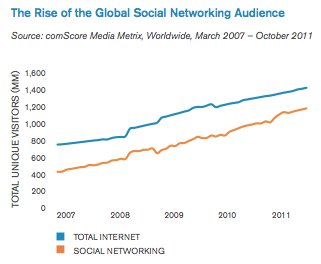
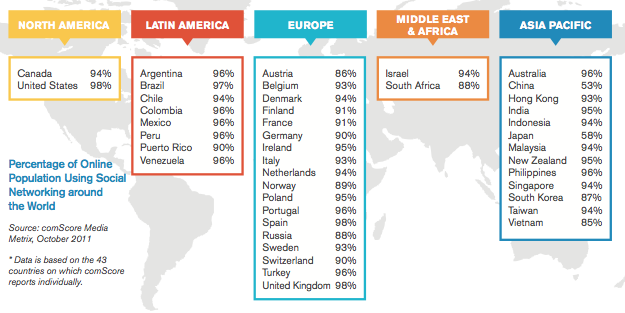
1 in every 5 minutes of time online is now being spent on social networking sites, up from a mere 6% in early 2007. The sites, led by Facebook, now reach 82% of the world’s internet-using population — about 1.2 billion people in total. This growth is happening across countries, with 41 of the 43 countries that the web measurement firm tracks showing penetration of 85% or more.


Within these big numbers, though, all sorts of differences emerge. People in Latin America spend an especially large portion of their time online on sites like Facebook and Twitter — 28%, or 7.6 hours per month. That’s much less the case in Asia, where it’s 11% and less than 3 hours per month. Those are broad averages, and full of anomalies. The Philippines, for example, is actually the most socially networked country in the world, with 43% of users time going to these services, and above 8.7 hours.
Facebook itself is making up the largest portion of all this usage — even as all sorts of rivals and alternatives are surging. The service reached 55% of the worlds’ online population in October, with incredibly high engagement: 3 out of every 4 minutes on these types of sites, and every seventh online minute. For the most part, it has surged into first places across countries that had previously been on rival sites, like Orkut in Brazil.

But Facebook is running out of new users in North America and Western Europe simply because it has so much of these markets already (even though it’s not running out of users’ attention). In the meantime, a whole other crop of social sites are booming everywhere, led by Twitter.

The microblogging service has grown by 59% in the past year to reach 160 million monthly unique users worldwide. Professional social network LinkedIn has grown by 55% to nearly 100 million. Easy-blogging site Tumblr is up 172% to nearly 40 million; Chinese Twitter-style site Sina Weibo shows almost identical growth (albeit mostly in China).


Report co-author Andrew Lipsman says this is one of the trends that was most surprising to him about the report. There’s more and more people who want to share around interests, not just the close social relationships.

All in all, many of these market leaders are also showing just how global they are these days, with Twitter and Facebook each now having 80% of their users outside of the US.

The report has all sorts of other data gems, too. Here’s a few that jumped out at me:
- Google+ now has 65 million users worldwide. That thing has some legs, even if we don’t always see them here at TechCrunch.

- Women continue to lead men in engagement across the world — by 2 hours or 30% per month in North America and Europe. This is a long-term trend that comScore has seen across older services like instant messaging. But, men have shown a 10% bump since July of 2010, and they gradually appear to be catching up. A lot of this has to do with age. Usage is about at equilibrium among younger age groups, Lipsman notes.

- Mobile is crucial to usage in many markets and growing, but continues to account for a minority of overall usage. Between a quarter and a third of users in Western markets reported accessing social networking sites at least once a month from mobile devices.

- Ads are still playing catch-up to spending levels per traffic that you’d expect to see in other areas.

- Email usage has been declining in usage among younger age groups, a trend that’s not likely to change.

This is by no means all of the interesting data in the report. You can download the full thing on comScore’s site, here. I should note that it deserves credit for doing an especially good job providing easy-to-read data visualizations — something that you don’t see often enough amidst all the awful infographics out there.

ComScore’s methodology, considered by many to be the best in the measurement business, includes large-scale opt-in user sampling around the world and across desktop and mobile devices.