Make Your Content Make a Difference
Advertisement

Content, content, content. It’s an obvious part of any interactive experience. In fact, you’ve probably heard content is king, or queen, or some sort of royalty. Yet, content is elusive. Often, you don’t realize your content isn’t cutting it until it’s too late. Does any of this sound familiar?
- Delayed projects.
- Broken designs.
- Uneven voice.
- Low-performing landing pages.
- Dead social media channels.
- Customer confusion and service calls.
These problems and more are documented extensively,[1] so I won’t dwell on them. What I will dwell on is the solution. But, first, let’s discuss the false ones.
Beware Of False Solutions
Just because someone articulates a problem well does not mean someone knows the solution. That’s when we’re susceptible to a false solution. In my many years of experience, I’ve found these two fake solutions to be very common, very distracting — and very disappointing.
SEO (Search Engine Optimization) Snake Oil
Oh, poor JC Penney. This major retailer fell victim to SEO snake oil, such as buying extensive link placements and other “black hat” techniques. And, JC Penney fell hard, with a detailed and brilliant expose of the situationmaking The New York Times, no less.
Now, besides avoiding embarrassment, I suggest that you avoid SEO snake oil because it will not bring you results. The spirit of a search engine is to find quality content. A search engine algorithm factors in signs of good content. When someone focuses on tips and tricks to game search engines instead of publishing quality content consistently over time, that person is missing the spirit of SEO. And, sooner or later, that person’s results will suffer for it. Google might punish the website or, more likely, the website will get the wrong kind of traffic, or visitors. If you drive lots of visitors to your content instead of attracting visitors who are interested in the content topics, you will be disappointed with the results.
And, now, a big caveat: I don’t think all SEO is bad. There are legitimate SEO concerns, techniques and advisors. Just remember that SEO tricks are not magic pills for your content ills. If you’re spending lots of time and money on SEO but not much on content, you’re on the way to disappointment.
Andy Budd recently discussed a closely related point of view in his recent article. He requests to “white hat” practitioners to distance themselves from the world of SEO, stop talking about search engine rankings and start helping clients deliver real value to their users. Therefore we should stop defining ourselves by the discovery medium and focus on the content itself, he rightfully argues.
Overpromised Technology
What else is not a magic pill? A technology product or feature alone. I see this false solution most often with larger companies, who put unrealistic expectations on products and tools such as a content management system (CMS), an analytics tool or a web application. For example, a prospective client recently vented to me that his organization spent $100,000 on implementing a new CMS but absolutely nothing on planning and creating content worth managing. The result was a one-person Web team destined to fail with its brand new CMS. This short-staffed team was saddled with:
- managing every aspect of a very large website,
- responding to strange or political stakeholder requests for new content and
- dealing with the boss’s frustration with the lackluster content.
Sounds awful, right? Unfortunately, this situation is too common. And it needs to stop.
The Real Solution
No SEO trick and no technology product alone will solve the content problem for you. The real solution to the content problem is hard work that demands change in your (or your company’s) approach to planning, designing and developing interactive experiences. That’s what gets results. There’s no shortcut. And indeed, the path to content that counts is a hard road. But it cannot be the excuse for compromising the quality of experience we provide to our users.
Get Strategic
Content strategy is planning for every aspect of content to get results. That goes far beyond writing the copy. When getting strategic about content, focus on three key areas: analysis, editorial and architecture. While explaining content strategy in detail literally requires a book (or two or three), I’d like to share with you a concise introduction to each area in this article.

Figure 1: Content strategy usually involves analysis, editorial and architecture.
1. Analysis
Analysis is taking a magnifying glass to your content situation. The better you understand it, the better you can plan exactly what needs to change to reach the results you’d like to have. Two typical activities in the analysis phase are a content audit and a context analysis. Sometimes, these activities are lumped together into a content analysis. The exact term is not that important as long as you do the analysis thoroughly.
Content Audit
An audit is a close review of your existing content. If you have any content to start with, you need to knowexactly what it is. The audit tells you what you’re working with. By the end of an audit, you’ll have answers to questions such as:
An audit is a close review of your existing content. If you have any content to start with, you need to knowexactly what it is. The audit tells you what you’re working with. By the end of an audit, you’ll have answers to questions such as:
- What content types, formats and topics do you have?
- What is the quality of your content? (For help, consult this content quality checklist.)
- How is your content structured?
- Where do you have obvious content gaps and overlaps, or redundancies?
When you’re ready to try a complete content audit yourself, check out the guide Content Analysis: A Practical Approach.
Context Analysis
A context analysis looks at the elements that surround and affect your content. At a minimum, consider and answer these questions about your goal, your users, and your processes.
A context analysis looks at the elements that surround and affect your content. At a minimum, consider and answer these questions about your goal, your users, and your processes.
Goal
- What is your business or organizational goal? Why?
- How will content help you achieve that goal?
Users / Audience
- Who are your users, or the people you want to attract and influence? Why?
- Where (in what channels) are your users looking for content — on websites, on mobile, on social networks?
- If you have an existing website or interactive experience, how is it performing?
Processes / Ecosystem
- How do you create, maintain and govern content now?
- How do you plan to do so when you launch the website or interactive experience?
- What are your competitors doing in the realm of content?
As a simple example, let’s look at American Express’ OPEN Forum, a site for small business owners. Why did American Express want to attract and influence these users? Because reaching these users was a step toward their business goal. Mary Ann Fitzmaurice Reilly, SVP of Partnerships & Business Development for American Express OPEN, notes, “…our biggest opportunity is with small business growth — if they grow, we grow.” And, American Express decided to help them grow through a unique approach to content. Rather than create more content about their credit cards, American Express decided to create content about small business owner concerns. (More about this approach in the next section, 2. Editorial.)
We could discuss analysis for days, but I’d like to introduce other aspects of content strategy to you as well. For a more detailed explanation of this analysis, I highly recommend the analysis chapter of Content Strategy for the Web by Kristina Halvorson. Also, I shared my step-by-step experience in the presentation Content Analysis: Know Thy Content.
The real benefit of analysis is ideas and insights for planning content editorial and architecture. So, let’s take a closer look at those sides of content, using the OPEN Forum as an example along the way.
2. Editorial
Editorial plans mostly for the people side of content, such as:
- What style or voice should your content have to attract and resonate with users?
- What topics and themes should your content cover and when?
- Who is responsible for what content?
- What are your standards or criteria for credible content?
Many businesses and organizations who are not media properties completely lack editorial oversight for their websites and other interactive experiences. That can result in problems ranging from errors to missing a competitive advantage. Let’s turn back to our OPEN Forum example. In the world of finance, much content is a combination of dull explanations or legal mumbo jumbo. OPEN Forum takes a different approach.

Figure 2: In the stodgy world of finance, American Express OPEN Forum offers a fresh approach to content.
The design might not look dramatically different from other finance sites, but the content is much different. To help small businesses, OPEN Forum regularly offers credible content about topics that small business ownerscare about. American Express produces some content, invited expert columnists create some content, and small business users contribute some content. Even though different authors contribute content, the content isoriginal to OPEN Forum. Can you notice how different it is from aggregating random content or simply optimizing pushy landing pages? Through its consistent voice and handy content on OPEN Forum, American Express haspositioned itself as a trusted advisor to small businesses. Because the articles, videos, and podcasts are deeply useful to small business users, they’re far more valuable to American Express.
Of course, having so many content contributors poses some risk of creating content that feels disjointed. To reduce this risk, what’s going on behind the scenes? The right editorial staff and processes ensure the content from different authors is coordinated. For example, while most websites lack an editor, OPEN Forum has an editor-in-chief. And, for robust editorial review and production, American Express partners with Federated Media. As you plan your content processes, you will consider what roles to hire in-house and what roles to hire as freelancers.
Besides the right people and processes, editorial planning results in an important tool: the Editorial Style Guide. This guide documents important decisions about your content for everyone involved to reference. A style guide typically explains:
- Target audiences / users
- Key messages
- Voice and tone
- Criteria for topics
- Sample content
- Usage, punctuation, and grammar guidelines
- Trademark and legal considerations
For a helpful start, you might want to consider taking a look at The Yahoo! Style Guide.
So, all of this editorial work sounds interesting, but does it actually get any results? Yes, it does. Since 2007, OPEN Forum has built an audience comparable in size and engagement with other small business media properties. But that’s not the best result. In the lucrative small business market, American Express’s successful editorial approach is a differentiator. More than that, it’s a quiet coup. The results did not happen overnight. They took time. But, compared to its competitors, American Express now owns small business online.
I know what you’re thinking. “But American Express is a big company. Should a smaller one care about editorial?” Yes. A smaller company or an individual can do it on a smaller scale, with less content, fewer contributors, and probably fewer visitors. Editorial is about attracting the right visitors (or audience) and holding their interest through content. Size does not matter nearly as much as quality.
That’s a basic introduction to editorial. But, content concerns don’t stop here. Now, let’s turn to architecture.
3. Architecture
Architecture plans mostly for the machine side of content — while keeping the people side in mind. Architecture addresses how your content is organized, structured and repurposed. Architecture gets your content to the right place. This planning might start with a site map but won’t end there. You likely will need to define content models and taxonomies using metadata. In essence, you need to tell your content management system and other platforms what content you have, where to display it and how to display it.
Let’s look at a simple example, again from American Express OPEN Forum. The site has clearly defined templates for its articles, videos and other content types. Those content types come together (or aggregate) as meaningful topic pages. Take a look at this one for innovation. That aggregation happens dynamically because of good architecture.

Figure 3: This topic page brings together all of OPEN Forum’s original content about a topic (in this case, the topic is innovation), thanks to good architecture.
When you plan architecture well, you gain other benefits. Both search engines and people will find your content more easily. Your content becomes more accessible and flexible, not to mention easier and more efficient to keep consistent.
That’s some basic architecture. Now, let’s kick it up a notch. Is OPEN Forum part of AmericanExpress.com, the core American Express website? No, it’s not. Now, that might bother some user experience designers and information architects out there. Shouldn’t this be one cohesive experience? Yes, it should. But, that doesn’t necessarily mean all of the content has to be in one website or in one place. AmericanExpress.com serves more visitors than small business owners. So, putting all that small business content on AmericanExpress.com could easily get in the way of other visitors. Instead, OPEN Forum and AmericanExpress.com link to each other at relevant points.

Figure 4: OPEN Forum is not part of the core American Express site.
Okay, now let’s kick it up several notches. Content strategy pioneer Rachel Lovinger has articulated convincingly that advanced architecture also makes your content more nimble to use across different interactive experiences, from your website to your mobile application. She notes,
“Publishing content that’s marked up with smart structure and metadata allows it to be delivered on a wider range of channels, while still retaining the context and relationships that make it meaningful and useful to both your audience [visitors or users] and your brand. Think of it like providing publishing instructions with the content, where each different platform uses only the instructions that are relevant.”[2]
For example, if your content is structured well, you can offer mobile versions of your content more efficiently, as American Express has. You also will have a much easier time creating widgets or an API to distribute your content, as NPR did. (See image below.) Does this kind of planning get results? Within 12 months after releasing this API, NPR doubled its users (audience). [3]
 Figure 5: NPRstructured its content well enough to offer a useful API.
You or your organization might think such multichannel architecture issues are mostly technology issues. Now hear this: They’re content issues, too. Consider how your content’s architecture will help you reach the right users in the right channels.
How These Areas Work Together
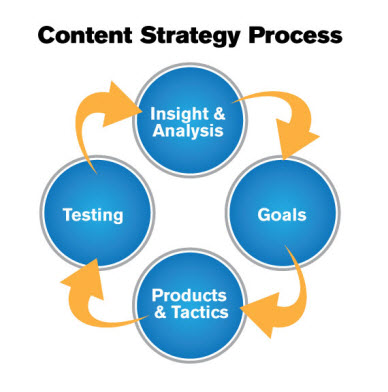
My diagram presents the areas of content strategy as a cycle. Now that you understand each area better, let’s look further at this cycle.
Before Launch: Architecture Last
When you’re about to reimagine a website or launch a new one, focus on analysis, then editorial, and then architecture. Why architecture last? Because that way you don’t waste time and energy planning areas of a site that you don’t need. You avoid scrambling to fill unwanted screens and features with content. You’d never build a house by constructing every possible room, then deciding which rooms you actually need. It should be no different with websites and interactive experiences. Plan the content you need first, then architect it.
When you’re about to reimagine a website or launch a new one, focus on analysis, then editorial, and then architecture. Why architecture last? Because that way you don’t waste time and energy planning areas of a site that you don’t need. You avoid scrambling to fill unwanted screens and features with content. You’d never build a house by constructing every possible room, then deciding which rooms you actually need. It should be no different with websites and interactive experiences. Plan the content you need first, then architect it.
After Launch: Analyze and Adjust
After you launch, the cycle doesn’t stop. Analyze how your content performs. Learn how users behave with your content. Stay in touch with industry trends. Watch for problems and opportunities. Address them by adjusting your editorial and architecture. Successful media properties never publish content, then leave it. I like how Tracy V. Wilson, Site Director for HowStuffWorks, describes her approach to ongoing analysis,
After you launch, the cycle doesn’t stop. Analyze how your content performs. Learn how users behave with your content. Stay in touch with industry trends. Watch for problems and opportunities. Address them by adjusting your editorial and architecture. Successful media properties never publish content, then leave it. I like how Tracy V. Wilson, Site Director for HowStuffWorks, describes her approach to ongoing analysis,
”When we’re looking at metrics, we’re looking at them in light of how we already know our articles work, how we know that they’re structured, how we anticipate that an average reader would come in and go through the article from beginning to end. And we can do the same thing for different types of content. So, we have articles, we have top ten lists, top five lists, quizzes, image galleries … and we’ve developed a different sense of what “normal” is for each of those.So, we’re able to look at when something is deviating from our idea of normal and try to figure out why that deviation would take place. We also use metrics a lot in day-to-day planning, like planning what to feature on our home page … deciding whether that day’s home page was successful; a lot of that is coming from numbers and whether people’s behavior on the site that day is matching up with … what we’re thinking of as the typical user behavior.” [6]
Get To Work
By now, I hope you appreciate more how analysis, editorial, and architecture work together to make content matter. The next step is to tackle your content. But, how? Every situation is a little different. For example, you might feel you have a good start on content analysis and architecture, but you have no idea how to approach editorial. These resources will help you get your specific plan together so you can move forward:
- Content Strategy Deliverables
This blog post series by content strategy expert Rahel Bailie explains typical content strategy deliverables in handy detail. - Content Strategy knol
Started by editorial and content strategist Jeffrey MacIntyre, the knol indexes content strategy definitions, insights, blogs, publications, specialists and more. - A Checklist for Content Work
This excerpt from Erin Kissane’s new book on Content Strategy, The Elements of Content Strategy, notes some essentials. - Content Strategy Meetups
If you want help with content or just some camaraderie, look for a content strategy meetup near you. If not, consider starting one yourself. When I started the meetup in Atlanta, I was happily surprised by the interest from developers, designers and marketers. - Content Strategy Forum, September 2011
This conference in London will bring together an international mix of well-known and new voices in content strategy. I’m as excited to see what others contribute as I am to offer a hands-on workshop.
Also, I recently wrote a book called Clout: The Art and Science of Influential Web Content, which explains practical principles for planning content. Along the way, I included examples from startups, government, higher education, large business, and more to inspire useful ideas. I invite you to learn more about the book.
Really, there’s no reason not to take the next step toward better content today. The sooner you move forward, the sooner you’ll overcome those content challenges. And, the sooner you’ll get results.
References
[1]. Halvorson, Kristina. 2009. Content Strategy for the Web. New Riders.
[2]. Jones, Colleen. 2011. Clout: The Art and Science of Influential Content. New Riders.
[3]. The Future of Content: Mobile Strategies for Government (panel). Government Web Content and New Media Conference 2011.
Segal, David. February 2010. Search Optimization and Its Dirty Little Secrets. The New York Times.
Jones, Colleen. 2009. Toward Content Quality. UXmatters.
Neisser, Drew. July 2010. What American Express’s OPEN Can Teach Us About Social Media. Fast Company.
Lovinger, Rachel. 2010. Nimble. Razorfish.

Colleen JonesColleen is the author of Clout: The Art and Science of Influential Web Content. As principal of the Atlanta-based consultancy Content Science, Colleen helps everyone from startups to Fortune 500 companies improve results from their web content. When she isn't helping clients, she is blogging about content strategy at Winning Content.