Thursday, June 9, 2011

Finding Creative People Is Easy (and Here's How)


Finding Creative People Is Easy (and Here's How)

Instead of searching for creativity, we should be fostering it in people we already work with—and redefining what it is

4455910733_fd2c8d8be1_o_wide.jpg
I recently asked a room of 40 executives to raise their hands if they thought of themselves as creative. This was a group who had been hand selected from their corporation as the future of the company, the big up-and-comers. Only three hands went up.

It feels as if just about everyone is looking to bring creativity into his or her organization. The theory seems to go that hiring creative people could bring much needed innovation, new thinking, and organizational revitalization. A recent study by IBM demonstrates CEOs' belief that "creativity" is the key to success for their companies in the coming years—more than "rigor, management discipline, integrity or even vision." So, if creativity is the key to the future of business, then why aren't more executives raising their hands?

The fact that these professions may be overlooked as creative is in part because only certain fields are labeled "creative" and others aren't.
One reason creativity is hard to claim as a personal trait might the popular image of the creative genius: a lone figure, someone who was born to create and is driven by an inexplicable compulsion to make art. While these creative people inspire us, they aren't necessarily the ones corporate America is looking to stock up on. Then there is the equally popular counterargument to the creative genius theory, spearheaded by Ken Robinson, that we are all born creative and the educational system sucks it out of us by the time we're a few years into school.

This second theory is a little more compelling to those of us who aren't tortured artists and/or have bills to pay, because it implies that we could be creative again. However, many of us don't need to be re-taught to be creative, we just need to be supported creatively, especially at work. Creativity in the workplace requires context. At work creativity is not a personality trait. It arises out of an ecosystem.

Creative thinkers are not the rare commodities that we tend to make them out to be. If you are running a business and want the innovation, flexibility, and problem-solving power of creativity, you don't necessarily have to hire creative people. You probably already employ them. I define a creative person as someone who has the ability to identify and deeply understand a problem, and then solve that problem by breaking the conventions of the status quo. By this definition, tortured artist or not, all of us can probably think of plenty of individuals we know who are creative.

The best teachers are usually the ones who don't do things "by the book." The same goes for great doctors, entrepreneurs, mail carriers, and even tax accountants. All of them are in a position to know the problem well and, when given enough leeway, can find a successful solution. Even at our frog office in Austin—a veritable shrine to creative thinking—one of most creative staff members is the receptionist, Elena, who is an intensely skilled problem-solver. The fact that these professions may be overlooked as creative is in part because only certain fields are labeled "creative" (design and advertising, for example) and others aren't. This is a symptom of the larger problem, and a dangerous notion if we are relying on creativity to bolster the business world.

So what can you do? First, find the clever, original thinkers who want to do things a little differently and then give them the tools and the rules they need to do just that. Here are some tips for finding the creative people who already work with you: 
  • Creative people are empathic. In design we formalize this through design research, but in other fields you might find that the people who are always thinking of the human point of view (either of your customers or your other employees) are very creative.
  • Creative people ask for help. Creative problem-solving requires collaboration and the understanding that solutions will emerge while working with a team rather than alone in a cubicle. Creativity rarely thrives in an environment where colleagues are pitted against one another.
  • Creative people ask questions (and question the status quo). Some of the most creative folks you already employ could be the ones who have been pestering you about making a change in the way you are currently working. Listen to them. 
  • They might be hiding. Remember that the creative people in your organization might not be the current top performers. If your culture doesn't support them, they might be feeling stifled or underappreciated. 
We say we want these creative people to challenge the status quo and drive innovation, but this often requires behavior that most business cultures don't support: occasionally breaking rules, pushing things through without "permission," and not "making numbers." In many corporate cultures, those behaviors are considered risky. So, now that you've identified them, how do you support these newly found creatives in your workplace? 
  • Redefine success. Find performance measures that reward creative thinking. This could mean rewarding teams as a group, or having prizes for the most fringe idea. It definitely does not mean sticking to traditional performance measures like quotas or number of billable hours. 
  • Get physical. Provide physical space that supports sharing and "cross pollination" of ideas. Bonus points for physical space that supports building, drawing, and thinking with your hands.
  • Encourage wild ideas and ideas that are backed by human need. This has to happen at the leadership level. Don't ask "How big is the market?" before you ask "What need are we answering with this idea?"
  • Get in the habit of presenting ideas before they are baked. Allow for more ideas to be presented sooner and in rougher form. It's a lot easier to kill something mediocre before you've invested in it (financially and emotionally).
  • Let team members really get to know each other as humans. We are much more likely to collaborate with people we know (i.e. have empathy for) than those who are just "That guy from marketing."
  • Support qualitative research activities. Let people within your organization get in "the field" to learn about your customers or your customers' customers.
For those of you who are the hidden creative in an organization, be known. Take a few risks, find the like minds, and keep asking questions. And for heaven's sake, if someone asks you to raise your hand if you think of yourself as creative: Proudly claim it!
Image: andymangold/flickr

Friday, June 3, 2011

The Art of Design Research (and Why It Matters)


I think that if you replace the word "designer" with "content strategist" in the following article, the big idea still applies. Content doesn't exist in a vacuum.


The Art of Design Research (and Why It Matters)


Design can exist without "the research." But if we don't study the world, we don't always know how or what to create.
Recently, my colleague Ben McAllister contributed a piece to this section called "The 'Science' of Good Design: A Dangerous Idea." In it he cautioned against a simplistic view of research as it applies to the design process because it's often synonymous with science—a discipline known for providing "hard truths" about the world. This leads people to believe (sometimes falsely) that "the research" will do the same for business. I am a researcher and a designer, and his article does raise a worthwhile question: "What is research good for, and how can we use it for the purpose of design?"
Designers thrive when they have a working concept of what makes people tick, a context that allows them to shape their ideas by considering what people covet and use, and somewhere to focus all their creative energy. Research can provide the fuel for new ideas. To Ben's point, design research isn't a scientific endeavor aimed at finding truths. Our clients typically can't afford the large sample sets and extended time frames necessary for such a "scientific" process.
And sometimes design teams don't have the patience to see the value in dragging out a study in an effort to make it scientifically or statistically significant. We're just not wired that way; we prefer to make and experiment and then analyze later. So what is research good for?
1. Learning about people's behavior
Behavior is fertile ground for design. Not just human behavior, but systems behavior: social, technical, environmental, political, and economic systems. Increasingly, we are faced with ill-defined problems that are related to the workings of entire systems. Long gone are isolated problems (and opportunities).
Understanding behavior gives designers at least two important kinds of insight. First, it provides a sense of action in the world, which can lead to empathy. For example, how does a patient go about finding his or her way to the radiology lab at a hospital for a first cancer treatment, and what is that way-finding experience like? Second, understanding behavior provides some clues about practices and patterns. For instance, many cancer patients at certain clinics memorize their medical record number in order to get treatment, and those numbers can be tied to schedules, appointment locations, and treatment plans.
2. Understanding and analyzing culture
What is culture and why does it matter to designers? Isn't culture kind of a fuzzy concept that is always changing? Yes, and because its elements are so deeply familiar and obvious to us we often don't recognize them as contributing to "culture" at all.
Yet culture is another important system when it comes to understanding design because it deals with the relationships we build between each other, our things, our routines, our view of the the world, and our beliefs. Anthropologist Clifford Geertz defined culture as consisting of "Webs of significance that man himself has spun...and the analysis of it [should] be not an experimental science in search of law, but an interpretive one in search of meaning." Asking simple questions about obvious things can lead to unexpected answers and rich insights.
A designer can reflect on these insights and use them to influence certain nuances in their designs. For example, using the metadata associated with a cancer patient's medical record number, such as appointments, schedules, maps, and customized directions of the hospital, adds meaning to a simple and common interaction at a hospital—getting directions. Placing a pathway on the ground to follow enables those same patients, who might often be self-conscious of their bald heads after treatment, to navigate very social environments without having to process the stares of other visitors.
3. Defining context
Context includes the physical and virtual settings that behavior occurs in and that culture shapes and emerges from. Identifying touch points—the decisive moments where a customer and a business intersect—is an important part of defining context. Using our hospital visit example, the designer and the larger design team (including the client if possible) can learn about context by watching the patient go through a process to see what happens, where it happens, and how they cope. By being a participant-observer, or seeing it all in pictures or video "from the field," a designer can gain a first-hand understanding of the real context for his or her work instead of designing from a distance.

4. Setting focus
Ill-defined problems, short project schedules, and a lack of patience are common conditions in design, and these can often lead to poor solutions. Doing research demands being comfortable with ambiguity in the early stages of a project in order to attain eventual clarity. This usually occurs through a process of synthesis—cutting the raw data down to size to find patterns and themes. It is this clarity that can enable a designer to focus on the right part of the problem at the right time in the right way. "But what should we focus on?" is one of the most common questions in the business. Even the legendary Charles Eames expressed a similar sentiment when asked about the boundaries of design. He responded, "What are the boundaries of problems?"
Design research is not "a science" and is not necessarily "scientific." It gives designers and clients a much more nuanced understanding of the people for whom they design while providing knowledge that addresses some of the most fundamental questions we face throughout the process. What is the correct product or service to design? What characteristics should it have, and is it working as intended? "The research" won't necessarily provide cold hard answers. But it will generate some good and feasible ideas.

Confab 2011: Four Truths for Content Strategy


from Razorfish

Tosca Fasso   June 2, 2011
From May 9 through May 11, worldwide leaders and luminaries in the content strategy field converged in Minneapolis for Confab 2011—the first content strategy conference in the U.S.
Now that we’ve absorbed the wisdom—and the sugar calories from the much-talked-about cake—we ask: what emerges from Confab 2011 as the challenges we were wrestling with, goals we were aspiring to, and themes that were beginning to emerge as truths? Here are our top four:
1) Content is a Business Asset
Kristina Halvorson of Brain Traffic, the organization that produced Confab, uttered this phrase verbatim in her rousing opening keynote, and it was also the title of Monday’s afternoon keynote by Valeria Maltoni of Conversation Agent. Ms. Maltoni stated that a business of any size can use content to attract, interact with, and influence customers.  Or, more directly, that a website is a “direct-to-consumer warehouse.”
But perhaps the most colorful expression of this idea was Erika Hall’s insistence that we can’t think of content as “pink goo.” Content, she emphasized, is part of a system and requires a continual process—quite a contrast to the too-common approach of wedging content into boxes one time and hoping it behaves itself until the next site redesign.
2) Content Strategy is Change Management
Karen McGrane, Razorfish alum and Managing Partner at Bond Art + Science had the courage and insight to articulate the reality we’ve all been wrestling with: our jobs really do require us to ask others to do their jobs differently. That doesn’t exactly set us up to be the most popular people at the table, so we need to articulate to our clients and coworkers why doing their jobs differently ultimately makes their jobs easier (admittedly after some painful adjustments).
Perhaps a subtler expression of this idea came from Ms. Halvorson, who showed an infographic with content strategy snugly embedded smack in the middle of a rather scary chart. The message of the chart? On a team of information architects, interaction designers, visual designers, copywriters, and programmers, only the content strategist has a direct relationship with every other role. In other words, the buck stops at the content strategist.
3) The Web Needs Human Filters
“No one is surfing the web anymore. The waves are too damn big.” Steve Rosenbaum of magnify.net  and author of Curation Nation , surely intended some humor when he said this in his session, but he balanced it with the serious understanding that online content has become overwhelming. We’re constantly checking email, losing sleep to keep up with the digital deluge. As a result, users have expressed their desire for fewer, more relevant choices—choices a human (likely a content strategist) needs to make.
Randall Snare and Elizabeth McGuane, creators of the content strategy blog, “Mapped,” discussed “context,” the idea that in order for content to be truly useful, humans (i.e., content strategists) need to not just analyze and test, but categorize and position. To properly do this, they implored us to ask such questions as: where are readers consuming our content, what are they looking at, and where are they looking for it? 
Snare and McGuane also asked us to think about content as the story behind the data, and data as what gives perspective to the story. In other words, content professionals have at their disposal multiple types of data (including analytics, user testing, metadata) but data is just one factor. Snare and McGuane warned content strategists that while data informs the process, it should not be confused with the process itself.
4) Everyone is a Publisher
A major theme in Steve Rosenbaum’s session, this idea was pivotal to the Tuesday keynote by Ann Handley. Ms. Handley advised that people and brands should embrace the reality that everyone is a publisher and start thinking about the web as a way to connect.
While it’s fairly easy to blindly embrace this concept and just put yourself out there, the real challenge is to ensure that your content is, as Ms. Handley so beautifully stated, “the soul of who you are.”
In other words, the idea that everyone is a publisher is not just an opportunity—it’s a responsibility as well. Ms. Handley’s book, Content Rules, contains 10 super-smart steps for being a responsible publisher. Although she titled them, “10 ways to make your content rule,” Ms. Handley’s advice could also be labeled, “10 ways to make sure that your content is the soul of who you are.”
As content strategists, isn’t it really our job to ensure that our clients’ online identities reflect their souls—just as interior designers or architects would do for their clients’ living spaces?
Confab 2011 provided not just articulation of this responsibility, but inspiration for doing this critical work. It also connected content strategists with a common vision—and perhaps most importantly, with each other.

Thursday, May 26, 2011

Make Your Content Mobile-Friendly


Make Your Content Mobile-Friendly

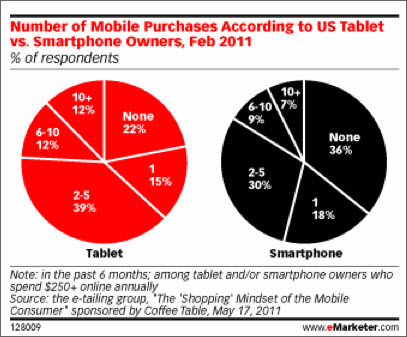
Is your content marketing mobile-friendly? Before you answer, look at these five salient mobile marketing drivers.
Smartphone ownership risesU.S. Smartphone ownership is expected to reach a tipping point in the U.S. according to Nielsen.
Mobile changes content consumption
Since the average U.S. adult spends over 10 hours a day consuming content, according toIpsos, content marketers should consider where and how users consume content.  In particular, information snacking (where users consume content during otherwise wasted time) and time shifting (where consumers read or watch content at a different times), are growing trends. For mobile devices, this often translates to information-on-the-go for content consumption in otherwise “wasted” time like commuting.
Mobile Internet users spend their time differently than computer users
Because people use their mobiles to stay connected, reading email accounts for roughly two out of every five minutes users spend on the mobile web, making it the most popular activity according toNielsen. Compare this to computer use where email is the number three activity on computers following social media and games.
Mobile search tends to be localRoughly half of mobile search has local intent versus 20 percent of Web search, according toSearchEngineLand. This means your mobile search strategy must be different to capture on-the-go users who need information where they are.
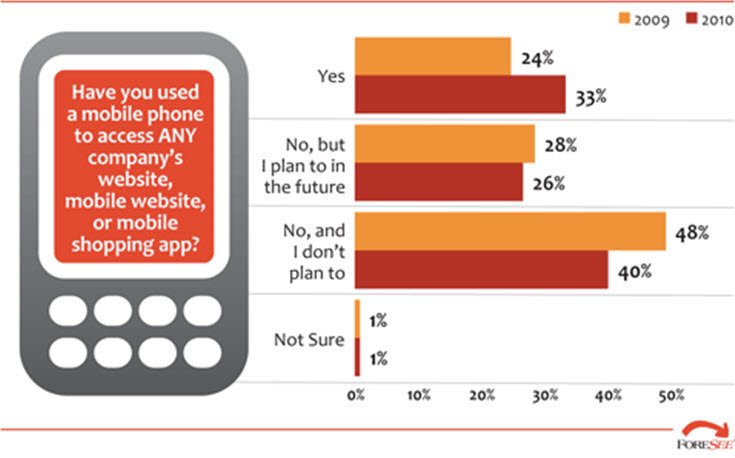
Mobile goes shopping and brings your competitors with themAccording to ForeSee research, one in three shoppers used their mobile phones to gather information in a retail store, and about half of shoppers checked on competitors.
To reach these mobile consumers, different types of content as well as mobile-friendly formats are needed to provide an optimal experience when and where your users want it. Do you have a plan to make your content mobile-friendly or are you hoping that your web-based content works on other devices?
To help you get your mobile content marketing strategy on track, here are six important elements that require mobile optimization.
Mobile search
Since mobile search helps on-the-go users navigate the mobile web to meet their immediate needs, users have different needs and use different keywords, it’s a good idea to have a separate mobile search budget and plan. You need to think differently about the words used and the content you serve to this audience.
Mobile websiteSince website speed and usage differs on a mobile, a mobile website focused on your users’ primary needs is a high priority for content marketers. Your mobile website must load quickly and should be function-oriented, allowing for easy scanning. On a mobile device, less is more. Also, due to the small screen, use larger buttons.
Text messagesUse this granddaddy of mobile communication that doesn’t require a smart phone for time-sensitive information like alerts and sales as well as reaching teens. This text-only (aka SMS) presentation is limited to 160 characters, so good copywriting is needed to keep your message brief and on target.
EmailSince email can be handled in small chunks of time and allows employees to stay on top of business developments, it tops mobile Internet use. From a content marketing perspective, optimize email copywriting for the small screen by using short, action-oriented headlines.
Mobile appsSince seven out of ten smart phone users have downloaded an app, consider creating an app of your own. The content marketing challenge is how do you provide useful product related content for users on the go? SitorSquat is a great example of how a major brand is providing useful content for consumers who are (quite literally) on the go. Don’t overlook the need to market the app and to get users to continually use it.
QR codesThe pop art squares provide a way to connect offline to online content and communications. For content marketers, QR codes provide an easy solution for linking offline content and buildings to online content, information and/or communications.
To determine which mobile elements are most important for your content marketing, start by looking at how mobile has influenced and changed how we consume content. Assess how these traits apply to your target audience and which forms of your content offering need to be adapted for mobile consumption. In your assessment, don’t overlook the need to be present where your competitors are.
Which aspects of your content marketing have you adapted for mobile consumption and why? Please add your experiences in the comment section below.