Why Low-Difficulty Keywords Are Worth Your Time
Backlinks are the most influential ranking factor in Google's non-localized algorithm, according to industry experts. I won't deny that there are a lot of other factors that influence rankings, but it's also important that everyone in the SEO industry understand and appreciate the influence backlinks have on rankings.
Especially new businesses, with freshly created websites, need to understand this concept: Backlinks are a prerequisite to ranking. That doesn't mean you need to be obsessed with building links, and you should never automate your link-building in any way.
Rather, instead of resorting to shady link building tactics, you need to identify low-difficulty keyword opportunities is a way to find the search result pages you can realistically compete for with your current backlink profile.
If you're struggling to drive traffic through search engines because your high-quality content is ending up on the third or fourth page of Google search results, this guide will show you how to identify the keywords you could be ranking for right now without building masses of backlinks.
Start by Gathering a List of Prospective Keywords
You're going to need a pretty massive list of keywords for this tactic—at least 100 keywords. Using the Google Keyword Planner, plug in the topics you want to explore.
I usually start broad and then narrow my search down using related topics that pop up during this process. For example, if I have a client in the industrial coatings industry, I'll start by entering the phrase "industrial coatings" into the planner and seeing what it spits out.
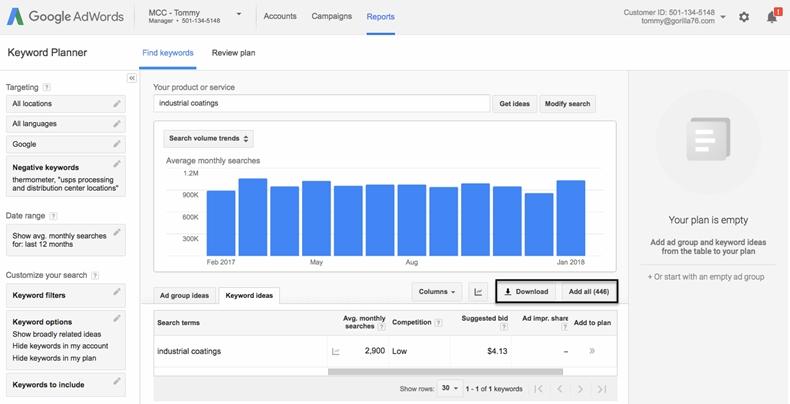
From there you can export the keyword list into Excel and start trimming the list down. I usually start by filtering out all of the keywords with over 1,000 searches a month: We're looking for the low-hanging fruit, and typically keywords searched over 1000 times a month will be too competitive to rank for without additional link-building and content promotion.
The keywords with lower search volume (between 50 and 200 monthly searches) are opportunities ripe for the picking. They are often terms your competitors are completely ignoring.
As you're going through this list, look for subtopics that would be worth creating content around. Subtopics in our example, the industrial coatings industry, might include things like fireproof coatings, fluoropolymer coatings, and zinc primers. Once you've identified your subtopics, plug them into Keyword Planner for a whole new list of ideas. Subtopic lists usually contain keywords with even lower difficulty than your original list, because the keywords are more specific.
To understand why subtopics contain great opportunities, look at the difference in the number of webpages in Google's index mentioning industrial coatings vs. those mentioning fluoropolymer coatings.
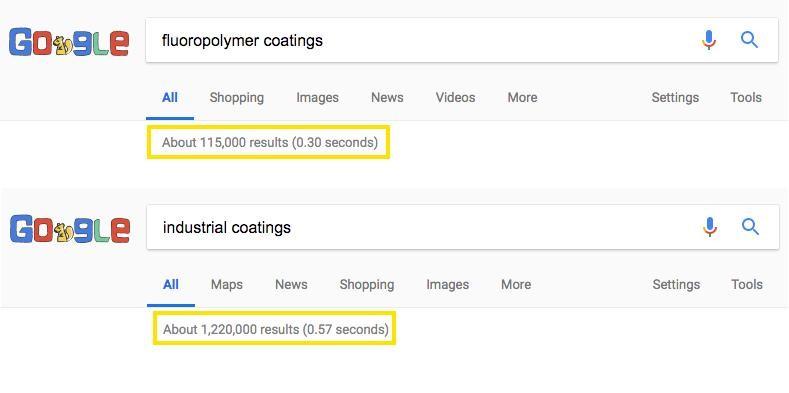
I'd be competing against 10 times as many webpages if I were to pursue "industrial coatings" over "fluoropolymer coatings." Of course, that is only a surface-level, anecdotal example, but it illustrates the importance of exploring niche keywords within your industry.
Once you have your list of at least 100 keywords, it's time to analyze them using Term Explorer and URL Profiler.
Combining Term Explorer With URL Profiler
Let me preface this section by saying I have no affiliation with these tools: They just happen to be the tools I use to analyze SERPs because I get to pick and choose the data I want. If you have a tool that can gather the top 10 results of Google for keywords at scale, you can substitute it for Term Explorer. And if you have a tool that attributes SEO metrics to URLs, it can replace URL Profiler. Though a tool like Moz's Keyword Explorer can be useful for finding low difficulty keywords, it doesn't provide the level of detail we're trying to achieve.
Fire up Term Explorer, copy-paste your keywords into its Keyword Analyzer, and select your location (the United States is the default).
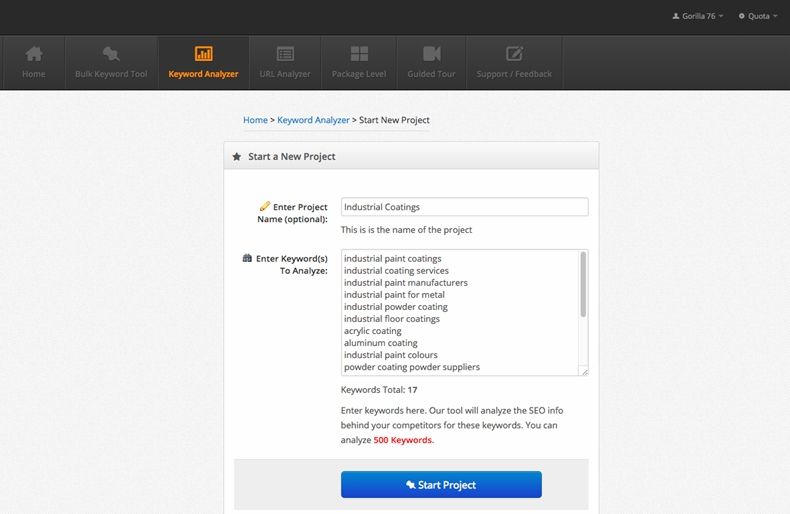
Start the project and grab a cup of coffee... Term Explorer is now pulling and ordering the URLs off the first page of Google for each keyword, and it usually takes a few minutes to process. Once you have your cup of joe, go into the project and download your CSV.
You'll be greeted with a host of data points for each URL: Number of keyword occurrences, word count, relevancy score, Ahrefs domain backlinks, difficulty score, etc. You could stop here and use Term Explorer's difficult score, but I like to be thorough and incorporate Moz's Domain Authority and Majestic's referring domain metric into this data set.
Trim down the data points you don't care about, and fire up URL Profiler. This software allows you to sync up Moz, Majestic, Ahrefs, SEMrush, and a dozen other SEO tools in order to "profile" each URL. Once you've synced up your link-metric software, you can import the Term Explorer CSV and merge your data set with the new metrics you've chosen.
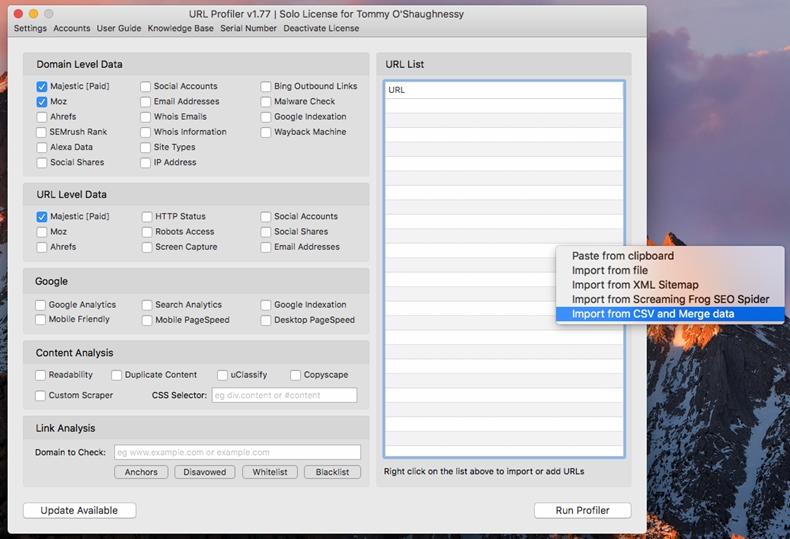
Combining Term Explorer and URL Profiler allows users to analyze Google's results pages using the metrics they trust the most! The beauty of this keyword research method is that it allows you to choose the metrics that matter to you.
Once you've merged your data, you'll get an even larger spreadsheet that you need to parse through, so I recommend trimming it down. Include metrics that analyze both on-page and off-page factors. Here are the metrics I typically use:
- Position (in Google)
- URL
- Keyword in the title?
- URL contains keyword?
- Do headings contain keyword?
- Number of keyword occurrences
- Moz Domain Authority
- Number of Majestic external backlinks pointing to the domain
- Number of Majestic referring domains pointing to the domain
- Number of Majestic external backlinks pointing to the URL
- Number of Majestic referring domains pointing to the URL
Once you have your most meaningful metrics, use conditional formatting to show GREEN when metrics indicate low competition (i.e., low authority, no explicit keyword targeting) and RED when metrics indicate high competition.
Once you've gone through each column and set up your conditional formatting, you'll be left with a colorful document that looks something like this:
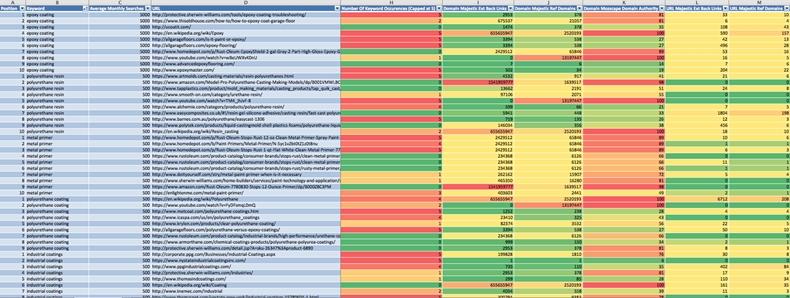
Conditional formatting allows you to quickly scan through your Excel sheet and find opportunities—you're literally looking for the weak links that are ranking in Google. Try to find URLs that have lower domain authority than your website, that don't have links pointing to their ranking URL, and that aren't explicitly targeting the keyword you're considering. These will be the URLs that are green across the board.
Another approach is to filter out all the competitors that have greater domain authority than your website. Let's say my client has 70 referring domains and 300 backlinks to their website. I can filter out all the URLs with more referring domains and backlinks, and focus on the competitors that are ranking with similar or lower domain authority.
After all our hard work, we're left with a treasure trove of low-hanging fruit keyword opportunities!
Assuming your website is technically sound (fast pageload speed, good internal linking structure, no penalties, etc.), you'll usually only need one excellent piece of keyword-targeted content to rank for these keywords, no link-building required (although it never hurts).
Final Considerations, Observations, and Thoughts
Think about this method as identifying the weak and irrelevant links Google is ranking and replacing them with your relevant, authoritative content. Of course, you need to be creating well-researched and useful content that Google wants to rank, but that's assumed in this process. If you're trying to rank for fluoropolymer coatings, but not answering a searcher's question about that type of coating or providing them with next steps to purchase or learn more, you're failing to answer the searcher's query and will struggle to rank.
While this method of keyword research works for non-localized (national) results, it doesn't apply to localized search results. Google is going to prioritize location over everything else when trying to answer a query like "industrial coating contractors near me." Local SEO is a whole 'nother beast, so double-check your opportunity keyword SERPs for local companies and the local 3-pack.
Another thing to consider is whether a partial match domain (or partial match company name) with low domain authority is ranking. Though the domain name itself might not be causing the company to rank, it's likely the company has enough keyword-rich anchor text linking back to its website to give it an edge. A company like "Frank's Industrial Coatings" gets an advantage in national organic results because its linked, branded mentions across the Web include the keyword "industrial coatings" in the anchor text.
* * *
This keyword research tactic has been incredibly effective in the industrial and manufacturing space because a lot of industrial companies are ignoring online marketing altogether. But I'm curious how it would hold up in more competitive verticals where SEO is a priority.
For those who experiment with this tactic, please reach out to let me how it worked for you or your client's business.